Building the UX practice
Writing down what good UX work looks like at World Wide Technology, from one team's habits to a catalog of six services
My role
Lead UX Designer
- Employer
- World Wide Technology
- Where
- St. Louis, then Phoenix
- Years
- 2018 to July 2022
- Practice
- UX, in WWT's software consulting group
- Built the DesignOps practice on the map-data checker team that earned my promotion to Lead UX Designer, and wrote the proposal for that role, which was approved.
- Wrote the Human Factors and the Accessibility and Inclusivity skill areas for the practice's career ladder.
- Wrote the UX Practice Overview, a catalog of six services tied to the roles that staff them.
- Wrote, as I recall it, the UX content and process documentation for the late-2020 comparison of usability-research platforms.
- Planned and ran the 2021 interviews on how UX shows its impact.
- Wrote the room scripts and content for the 5-day Lean UX workshop.
- Facilitated the Lean UX workshop for an insurer in 2019, and coached a room for an electric utility in 2020.
- Co-wrote the 2021 report from running the Lean UX workshop on our own sales team.
- 12 people promoted through the career framework, me among them, mine to Lead UX Designer in August 2020
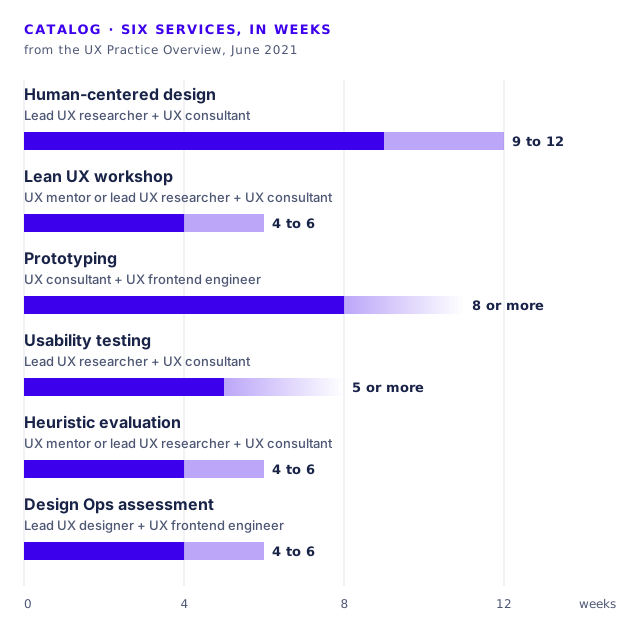
- 6 services in the catalog, each with its crew and a length from 4 to 12 weeks
- 4 + 1 Lean UX workshops for clients from 2019 to 2022, plus one for our own sales team
- Not measured sales won with the catalog, though it reached clients directly
Summary
On the map-data checker, a federal project, I had built the habits that kept a design team working to one standard every week: DesignOps, in the trade. That work got me promoted to Lead UX Designer in August 2020. The harder job was the one after it. WWT's designers worked inside many client teams, and nothing written down said what good work looked like at each level, or what the practice could sell.
Over the next year and a half I wrote the Lead role, two of the career ladder's eight skills, the 2021 research on how UX shows its impact, and a catalog of six services. Twelve people were promoted through the framework, me among them, and the catalog reached clients. Nobody measured what it sold, and this study says plainly where else nobody measured.
Who was involved
- Practitioners UX designers, UX researchers and frontend engineers working inside client teams.
- Practice leads The people who ran the UX practice, and the performance manager who reviewed my skill-area drafts.
- Product Ownership practice The sister practice we planned joint services with in 2021.
- Clients A federal agency, two electric utilities and an insurer took the Lean UX workshop.
Where it started
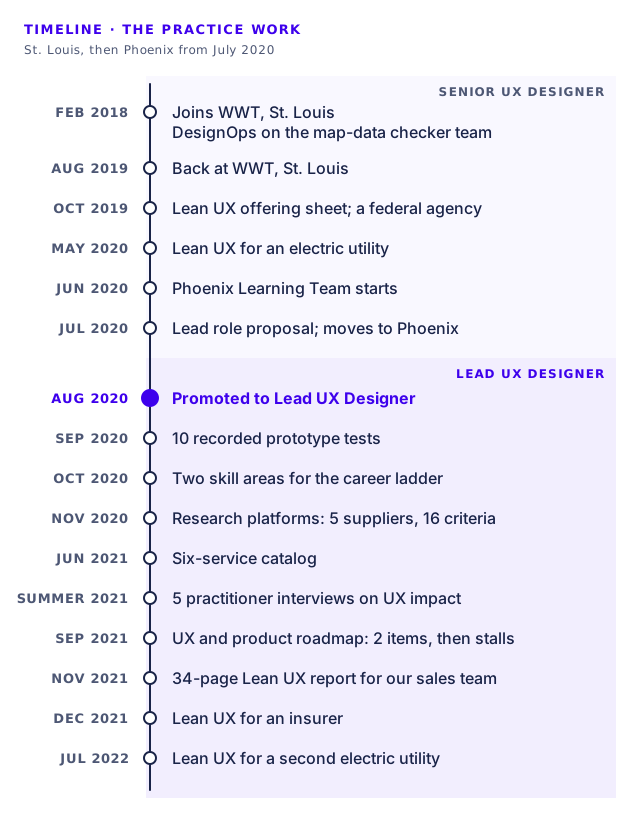
I joined WWT in St. Louis in February 2018 as a senior UX designer. I left late in 2018, was VP of UX Design at MediaCross, a St. Louis agency, in 2019, and came back to WWT in August 2019. On the map-data checker for a federal agency, I set up the team's DesignOps (design operations: the routines and tools that let a design team work to one standard every week). We held a weekly demo with research every two weeks, and built from a shared component library.
That was lead-level work with no lead title to go with it. In July 2020 I wrote the proposal for a Lead UX Designer role: draft 4 of the role description, dated July 10, set out four levels, Associate, Professional, Senior Professional and Lead, with the Lead mentoring the other three and running Lean UX workshops. The proposal was approved, and I was promoted into the role effective August 1, 2020.
Phoenix
In July 2020 I moved to Phoenix. I'd been asked to help open a new WWT office there, and I was one of the company's values interviewers, the people who talk with candidates about how they work with others. The pandemic changed that plan.
Instead, I adapted the map-data checker's DesignOps habits for new engineering teams in Phoenix, a group we called the Learning Team. My notes from its planning meeting are dated June 4, 2020. The teams built a small practice product to learn on, GO Fish, an ordering app for a sushi restaurant. It was a spike, a short project to learn what a kind of work takes before a client asks for it, and it prepared the team for fast-casual dining clients. The team didn't have a product owner yet, so I led those spike projects and mentored its four engineers through them. On September 8, 2020 we tested two versions of its prototype in ten recorded sessions on UserTesting, a remote testing service.
By my own account I didn't run it well, and an organizational change reshaped the group and then ended it. If I did it again, I'd start with one habit on one team, the weekly demo, and name who owns it, so it could outlast a change in the group around it.
Writing the ladder
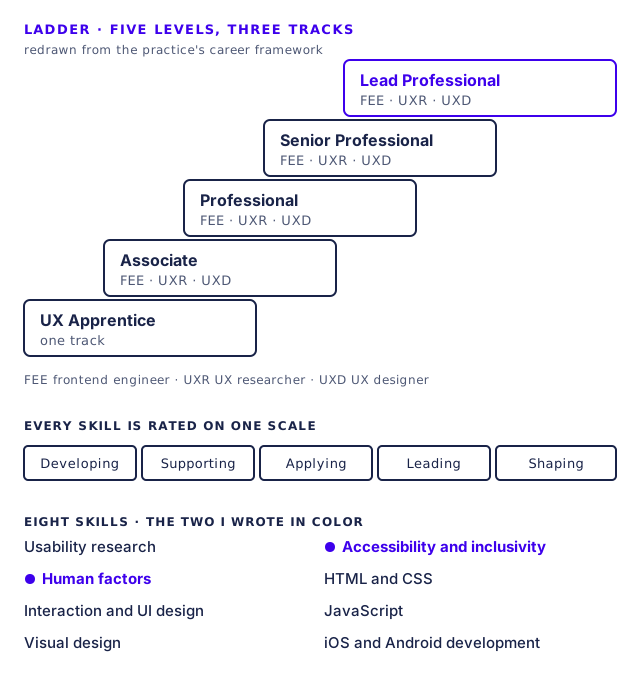
WWT's UX practice already had a career framework: a workbook a colleague started in September 2019 that rates every role on eight skills, across five levels from Apprentice to Lead Professional. What it didn't have was words. A cell said "Leading" and stopped there.
In the fall of 2020 I wrote two of the eight skills out in full. For each step of the scale I said what a person at that step actually does. Human Factors, finished October 15, follows the same five ways people take in information at every step, from noticing things to making decisions, and asks more of each at every level. Accessibility and Inclusivity, finished October 22, runs from knowing the guidelines (WCAG, the Web Content Accessibility Guidelines) to owning them on a project and including people with disabilities in testing.
That November, the practice also compared usability-research platforms: 5 supplier responses, graded on 16 criteria in a worksheet dated November 13, 2020. As I recall it, I wrote the comparison's UX content and its process documentation. Which platform it led to wasn't recorded.
Twelve people were promoted through the framework, me among them.
Six services
In June 2021 I wrote the UX Practice Overview, two pages that tell a client what the practice does. It lists six services. Each one opens with what the client is trying to do, in their words ("I have a product idea"), names the two roles who staff it, and says how long it runs.
Its last section ties the services back to the ladder. Professional, Senior and Lead each come with the skills they bring, and the Lead is the one who runs workshops, leads discovery and speaks for the practice in sales. It's the one document where the ladder, the skills and the services meet.
The catalog reached clients directly, in WWT's presentations of its engagement models. What it sold wasn't measured.
Asking how UX shows its impact
In May 2021 the practice set itself the goal of measuring and explaining the value UX brings, and I took it on. I wrote an interview guide of about 55 questions in four parts, screened six practitioners and interviewed five between June 21 and August 10, 2021. The same month the interviews began, I also took a UX course from the Nielsen Norman Group.
Four things kept coming back. Nobody could point to a written standard for good design work. The client owned the product's numbers, and the goals set at kickoff were rarely looked at again. When budgets got tight, research and design went first. And when a project went well, the story was rarely told. We followed the interviews with a wider survey, and as I remember it, 98% of the people we sent it to answered. Then we mapped our assumptions and held one-on-one follow-ups before finishing a report to leadership, which set the initiatives for the following quarter. The survey, the follow-ups and the report aren't in my archive, so that part is my account.
The Lean UX workshop
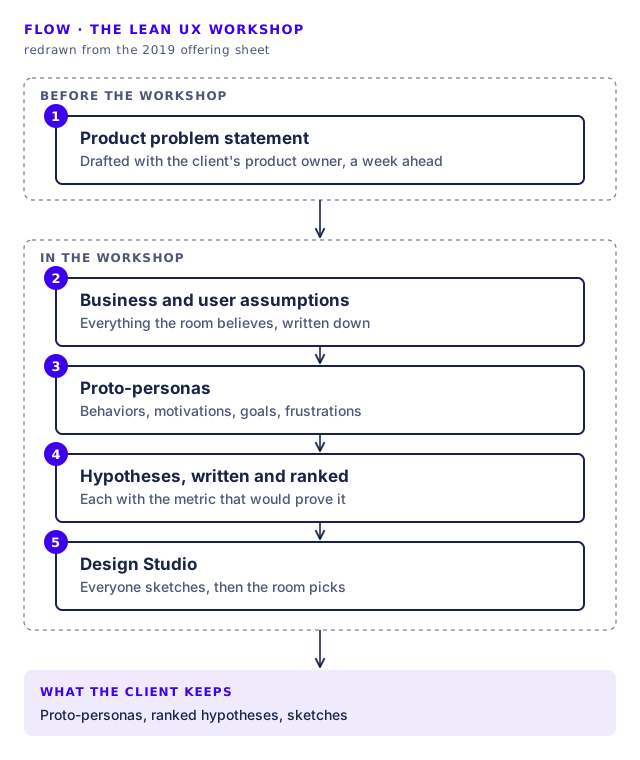
One service in the catalog already had a track record. The Lean UX workshop treats every design idea as a guess until it's tested, and our version was packaged in an offering sheet dated October 1, 2019: five activities in a fixed order, with the first one done before anyone's in the room. The standard workshop ran 5 days.
My archive dates its deliveries to a federal agency in October 2019, an electric utility in 2020, an insurer from late 2021 into early 2022 and a second electric utility in July 2022. I facilitated the workshop for an insurer in 2019, and for the electric utility in 2020 I was a room coach, supporting a facilitator in training. In 2021 we also ran it on WWT's own sales team, and I co-wrote the 34-page report that came out of it.
Room scripts (rewritten in 2026 from the 2019 offering)
I wrote the room scripts and content for the whole Lean UX workshop: the words a facilitator says to open and run each activity across its 5 days. The 2019 pages aren't in my archive, so I rewrote them in October 2026 from the offering sheet's five activities, following Lean UX the way most teams practice it. They are a rewrite, not the original pages.
Every example below follows one company I made up for this page: a regional field-service business that sends heating and plumbing technicians to people's homes and books the visits by phone. None of it comes from a client.
The five days
One activity a day, each handing the next something it can't start without.
-
1A week before
The product owner and I settle the problem statement in two 45-minute calls.
-
2Day 1
The product owner reads the problem statement to the room. Then the room writes its business and user assumptions and ranks them by risk.
-
3Day 2
Proto-personas, drawn in breakout rooms and merged at the end.
-
4Day 3
Hypotheses, each written in one template with its measure, then ranked by value and risk.
-
5Day 4
Design Studio: everyone sketches the top three hypotheses.
-
6Day 5
Storyboards from the merged sketches in the morning, then a one-hour readout to the sponsors.
Each day is one session of about three hours, so the people in the room still have their afternoons for their regular jobs.
Script 1: The problem statement, a week before
Goal: one paragraph the product owner owns, saying what's broken and how we'll know it's better. Time: two 45-minute calls a week ahead, then 20 minutes on Day 1. Materials: the planning guide's four-sentence template and the Problems box of the four-box canvas.
I open with: "You know this product better than anyone who'll be in the room. I'm going to keep asking how you know, and you're allowed to say you don't."
Steps: in the first call (45 minutes), the product owner fills in the four sentences: what the product does today and for whom, what's going wrong, what it costs, and the measure that would show it's fixed. Before the second call, they check each sentence with one person who does the work. In the second call (45 minutes), we cut anything that names a solution. On Day 1 (20 minutes), they read it to the room, which asks questions but doesn't edit.
The room coach watches for a solution hiding in the problem ("we need an app") and a measure nobody can count yet. It hands the next activity a problem the whole room has heard in one voice.
Example, invented for this page: "Our dispatchers book home repair visits by phone across three counties. Customers wait at home through four-hour windows, and too many visits end with nobody there. Each missed visit costs a technician an hour of driving. We'll know it's better when fewer visits need a second trip."
Script 2: Business and user assumptions, Day 1
Goal: get what everyone believes onto the wall, then find the beliefs that would hurt most if they're wrong. Time: the 160 minutes after the problem statement. Materials: sticky notes in two colors, one for the business and one for users, and a large grid that runs from "we know this" to "we're guessing" one way and from harmless to costly the other.
I open with: "Everything you write today is a guess, including the good ones. One belief per note. Write fast and save the arguing for later."
Steps: 20 minutes of silent writing about the business (who pays, and for what), then 20 about users (who they are and where they get stuck). 40 minutes to cluster the notes and name each group, a 15-minute break, then 45 minutes placing every group on the grid. In the last 20 minutes everyone gets three dots for the costly, guessing corner, and I read the winners back.
The room coach watches for the loudest person writing for everyone, and for beliefs stated as facts ("customers hate calling"), which get the question "how do we know?" The riskiest five or so assumptions go to the proto-personas.
Example, invented for this page: a business belief, "homeowners will pick their own arrival window if we offer it online", and a user belief, "dispatchers spend most mornings rebooking missed visits". The room votes the riskiest: homeowners will trust a window enough to stay home for it.
Script 3: Proto-personas, Day 2
Goal: agree on who we're designing for, as best guesses that research can prove wrong. Time: Day 2, 180 minutes. Materials: the proto-persona template, a sketch and a name over four boxes for behaviors, motivations, goals and frustrations.
I open with: "These people are made up on purpose. We're drawing who we think we serve, so research has something specific to prove wrong."
Steps: 15 minutes listing every kind of person who touches the service, then 10 to split into breakout rooms of three to five, one persona each. 45 minutes to fill the boxes and a 15-minute break. 45 minutes for each room to present in 5 and take challenges, 30 to merge duplicates and choose the primary two, and 20 to list what research should check first.
The room coach watches for age and hobbies standing in for behavior, and for a room drawing the user it wishes it had. Two or three proto-personas go on the canvas, and their frustrations become the "for whom" in every hypothesis.
Example, invented for this page: Dana has been a dispatcher for 12 years and keeps a paper copy of the day's routes in case the system goes down. Her goal is that no technician crosses the county twice, and one customer who isn't home at 2 p.m. undoes her afternoon. Luis, a homeowner who works shifts, can't wait through a four-hour window.
Script 4: Hypotheses, written and ranked, Day 3
Goal: turn the assumptions and personas into bets the team can test, each with its measure, and rank them. Time: Day 3, 180 minutes. Materials: the canvas, a grid of value against risk, and one template: "We believe [this change] for [this persona] will achieve [this outcome]. We'll know we're right when we see [this measure]."
I open with: "A hypothesis is a bet you can lose. If you can't say what you'd see if you're wrong, it isn't finished."
Steps: 20 minutes listing the business outcomes from the canvas, then 30 in pairs listing changes that might serve a persona and an outcome. 45 minutes writing each one in the template, a 15-minute break, and 40 minutes placing them on the grid. The room spends 20 minutes picking the top three to sketch and 10 naming the smallest test for each.
The room coach watches for measures that are really tasks ("launch the portal"), hypotheses with no persona in them, and one statement carrying several features. The ranked list goes to Design Studio, top three first.
Example, invented for this page: "We believe a text the evening before, letting Luis keep or move his window, will cut second trips. We'll know we're right when missed visits in one county fall for two weeks running."
Script 5: Design Studio, Day 4
Goal: everyone sketches, and each top hypothesis ends the day as one merged sketch. Time: Day 4, three rounds of 55 minutes with a 15-minute break. Materials: 6-up sheets (six boxes to a page), thick markers and a timer.
I open with: "Stick figures are fine. Six ideas in eight minutes means nobody's first idea is precious."
Steps, for each hypothesis: 5 minutes to restate it and its persona, and 8 to sketch six ideas alone. 20 minutes for each person to show their sheet in 2 minutes and hear 1 minute of critique, measured against the persona and the hypothesis, never the drawing. Then 10 minutes to draw one best idea, borrowing freely, and 12 for the team to merge them into one sketch.
The room coach watches for people who don't draw (hand them a marker), and for a room drifting toward the most senior person's sketch. One merged sketch per hypothesis goes to Day 5, where it becomes a storyboard for the readout.
Example, invented for this page: one sketch is the evening text with Keep and Move buttons, and another is Dana's board with unconfirmed visits in amber. The team merges them: the text goes out, and Dana sees who hasn't answered by 8 p.m.
Joint services with product ownership
In 2021 I was one of the UX practice's representatives in a working group with WWT's Product Ownership practice, planning services the two could offer together. Our roadmap ran from May to November 2021 in four steps, from agreeing on each role to working together during delivery.
By September 2, 2021 we had finished 2 items, a kickoff and a shared description of each role, and the group had set aside working together during delivery for the rest of the year. It stalled late in 2021, and nothing from it is dated 2022.
Outcomes
Twelve people were promoted through the career framework, me among them. Mine was to Lead UX Designer effective August 1, 2020, in the role I had proposed. The catalog reached clients directly, in WWT's presentations of its engagement models. In Phoenix, I mentored the four engineers on the Learning Team through spike projects I led before the team had a product owner, preparing for fast-casual dining clients. The 2021 research ended in a report to leadership that set the initiatives for the following quarter.
My promotion is in the role file. The other promotions, the catalog's reach, the proposal's approval, my roles in the workshops, the Phoenix mentoring and the research report are my own account, given in October 2026, and no file in my archive shows them.
The rest is not measured. Nobody counted what the catalog sold. The Lean UX workshop is used work, four client deliveries from 2019 to 2022 and one internal, but I have no measure of what any client did with it after we left.
If I did it again
I'd ask before I wrote. The 2021 interviews came after the ladder and the catalog, and they should have come first, so each document answered something practitioners had told me.
I'd also give each service one number to track from its first sale, so a catalog like this could show whether it worked. Today it can show that it reached clients, and not what it sold.